Canalblog Tous les blogs Top blogs Économie, Finance & Droit Tous les blogs Économie, Finance & Droit
Suivre ce blog Administration + Créer mon blog
MENU
Le juste nécessaire pour réussir un projet de changement avec vos collègues.
Publicité
13 février 2015

Un changement d'outil informatique chez mon loueur de voiture

On loue des voitures depuis un siècle. Les loueurs de voiture utilisent l'informatique depuis des lustres. Ce mardi après-midi, j'entre dans la casemate de mon loueur préféré, ma pré-réservation à la main. 3/4 h plus tard, la responsable d'agence me remet un contrat rédigé de sa blanche main après que l'opérateur ait épuisé ses tentatives et sa patience sur le système. Et vendredi, au retour de la voiture, c'est une impression brute, au format interne à la société de location, qu'elle me tend après 20 minutes de lutte avec le système. Trois jours plus tard, je me connecte au site internet pour récupérer ma facture pour remboursement de note de frais et le système répond : "Nous n'avons pas trouvé de facture". Fiasco.

Que s'est-il passé ?

Les informaticiens centraux ont changé l'application informatique durant le week-end précédent, les deux opérateurs dans la casemate ont été formés la semaine d'avant et pourtant plus rien de fonctionne comme ils l'attendaient, les deux super-utilisateurs de la région sont débordés d'appels et renseignent au compte-goutte. Retour au mode dégradé, papier-stylo.

Qu'en tirer comme enseignement ? Selon la grille ADKAR® :

Conscience du changement ? Dans la casemate, aucun des employés n'a justifié le changement style "ils ont fait ça pour telle raison". Ou bien ils l'ignorent, ou bien ils n'y croient pas.

Désir du changement ? Les employés y gagnent pour l'instant des ennuis - et encore, à l'instant "t", j'étais le seul client. Je ne veux pas imaginer ce que ça a donné lorsque le dernier train du soir a déversé une douzaine de cadres dynamiques en attente de leur voiture de location.

Connaissances ? Les employés compulsent le support de cours qui leur a été remis la semaine précédente et ravivent leurs souvenirs comme ils peuvent.

Capacités ? Ces deux personnes sont à égalité de connaissance et de pratique, pas de super-utilisateur parmi eux ; les lignes téléphoniques des formateurs sont occupées, un seul appel aboutira, celui passé à une autre casemate de la région, là aussi dépourvue de super-utilisateur.

Renforcement ? Les opérateurs me disaient : "Depuis que notre informatique a été concentrée en Angleterre, ils nous font des modifications comme ça sans qu'on sache vraiment pourquoi". Il n'y a donc pas de renforcement ?

Je m'adresserais bien à la société de location de voiture pour débriefer avec elle de cet épisode. Change Management : business d'avenir ? 

Publicité
12 janvier 2015

Manager le changement : un "elevator pitch".

A l'heure où nombre de projets peinent à réussir, savez-vous que le premier facteur-clé de succès d'un projet est l'implication des parties prenantes ?

Aujourd'hui, les équipes projet mettent en place un accompagnement du changement fondé sur l'information et la formation ("les participants auront 75% de bonnes réponses au quizz"), mais elles butent sur la résistance au changement des personnes qui ne désirent pas s'impliquer.

En adoptant l'approche Conscience-Désir-Connaissance, nous prenons la naturelle résistance au changement par le bon bout : d'abord chaque personne comprend le changement, puis elle a le désir de changer, puis elle est formée, coachée et finalement renforcée dans le changement.

Pour le commanditaire, c'est la somme des changements individuels qui aboutit à l'atteinte des objectifs business du projet. Et le projet a toutes les chances d'aboutir dans les temps et le budget qu'il a investi : comme tous jouent le jeu, l'organisation fonctionne et performe.

Nous préconisons une approche par le commanditaire, par les superviseurs et par les opérateurs, et nous aidons chacun spécifiquement selon son rôle jusqu'à ce que les objectifs business soient atteints. C'est ce qui nous différencie des autres approches.

Que diriez-vous si nous trouvions un moment dans votre agenda pour que nous nous voyions plus longuement et que vous puissiez décider si vous voulez essayer notre approche sur un projet concret ?

Pour une définition de l'elevator pitch.

5 février 2014

Pour un message percutant, l'elevator pitch

Michaël, pour ta recherche d'emploi, il y a, dans la droite ligne de l'auteur de référence (en ce qui me concerne), Richard Nelson BOLLES (Cf. son livre What Color Is Your Parachute?) deux plans dont nous venons de parler au téléphone, celui du courriel de prise de contact pour solliciter un entretien et celui du projet professionnel sensu stricto à développer au cours de l'entretien, sous forme d’elevator pitch.

Quant au projet professionnel, un elevator pitch, comme proposé par Isabelle Genest ci-dessous, est un outil puissant.

L'elevator pitch

Le rédiger, par écrit. Question taille, il devrait pouvoir être dit à haute voix en moins de 5 minutes.

Le point 6 (l'action à laquelle je vous convie) est le moment où je puis demander quelque chose à mon interlocuteur : son feedback, deux contacts de ses connaissances à qui je puis demander le même service, etc.

Et puis, après l'entretien, envoyer un courriel de remerciement au plus tôt, idéalement dans les 24 heures

Bon courage !

Pour un exemple d'elevator pitch appliqué au change management.

Sur le nouveau site projet-initiative101.com, la présentation de l'elevator pitch et un exemple réel d'elevator pitch avec mindmap.

23 juillet 2015

"La multiplication des chefs de projet est une catastrophe managériale majeure", affirme le sociologue François Dupuy

Lu sur le site de l’Usine Nouvelle, article de posté par Christophe BYS le 16 janvier 2015, http://www.usinenouvelle.com/article/la-multiplication-des-chefs-de-projet-est-une-catastrophe-manageriale-majeure-affirme-le-sociologue-francois-dupuy.N307730

En substance, François Dupuy développe l'idée que les organisations suscitent des chefs de projet pour faire de la transversalité là où prospèrent les silos, en vain.

Expérience personnelle : former ces mêmes chefs de projet aux yakafokons du management de projet donne rarement les résultats escomptés. Illustration de l’illusion commune à laquelle j’ai initialement sacrifié : le produit est bon (en l’occurrence le management de projet transversal), la formation est bonne (donnée par les bons experts), alors l’exécution suivra. Or, l’exécution suit rarement, parce que l'environnement des chefs de projet n'est pas prêt à les suivre.

François Dupuy propose d’aborder le sujet par un trio de prémisses : les gens sont intelligents, les gens font selon ce que leur environnement promeut, les gens évitent ce que leur environnement sanctionne. Dès lors, si l’environnement ne promeut pas la coopération et sanctionne les erreurs individuelles, multiplier les chefs de projet revient à uriner dans un stradivarius—ainsi qu'à décourager les violonistes et faire fuir les auditeurs.

Examinons les trois prémisses une à une.

  1. Les gens sont intelligents. OK, car s’ils sont stupides, autant adopter directement la dictature : je sais, vous faites. Mais nous savons ce qu’endurent les dictateurs.
  2. Les gens font selon ce que leur environnement promeut : si l'antiquaire donne $10 pour chaque papyrus, le berger rapporte plusieurs manuscrits de la Mer Morte car il a déchiré au préalable celui qu'il a trouvé. Cas cité par Rolf Dobelli dans « The Art Of Thinking Clearly ».
  3. Les gens évitent ce que leur environnement sanctionne : les préparateurs de l'avion collaborent avec leur coordinateur au sol aussi longtemps que c'est lui/elle qui assigne bons et mauvais points. Dès lors qu'une réorganisation prive le coordinateur au sol de ce levier de sanction, les coordinations se grippent et les vols prennent du retard. Cas Air France cité par François Dupuy dans « Sociologie du Changement ».

Du coup, l’introduction du management de projet invite à se poser la question suivante avec les parties prenantes : Pourquoi adhérer à une pratique qui désigne plus sûrement le coupable ? Un plan de projet clair et suivi ne pointe-t-il pas les responsabilités sans ambigüité ? Les coupables ne sont-ils pas sanctionnés ? Alors, résister à l’application du management de projet apparaît comme une stratégie intelligente : un plan de projet obscur et difficile à suivre est dans l'intérêt des acteurs dépourvus de maîtrise de leur environnement. De plus, le flou - et l’extrême précision, à l’effet identique - ouvrent des perspectives de négociation, d’arrangements. 

Il y aurait donc résistance intelligente à l'implantation du management de projet. Alors, que faire ?

Je puis me tromper, mais je suggère ces quatre points :

  1. Clarifier avec les commanditaires ce qu'ils veulent voir changer dans leur environnement. Des projets imprévisibles, des pénalités de retard, des collaborateurs burn-out, une image désastreuse ? Puis examiner avec eux quel management de projet est propre à répondre à ces attentes. Enfin, inviter les commanditaires à communiquer leur vision avec force et clarté aux manageurs, aux experts et aux chefs de projet.
  2. Passer de la formation "Yakafokon du management de projet" à la facilitation d’un groupe managers + experts + chefs de projet, donner aux chefs de projet en formation les moyens de se susciter un commanditaire/sponsor dans l'objectif d'initier un management de projet juste nécessaire. Cette approche part du terrain vers les décisionnaires (bottom-up).
  3. Former les stagiaires au management d’une initiative, c’est à dire d’une idée encore à préciser qui génèrera un projet (ou pas) mais qui transformera l’environnement de façon durable et efficace pour un mieux produire et un mieux-être au travail.
  4. Accompagner chacun selon le Modèle ADKAR®.
    .

En tous cas, c’est dans cet esprit que j’anime les sessions de management de projet qui me sont confiées.

27 mai 2015

Au lecteur perplexe devant une initiative à prendre

Mon sujet : vous aider à réussir votre initiative. Et ci-dessous, des réponses aux questions que vous pourriez vous poser.

Pourquoi manager une initiative est-il important à ce point ?

Parce qu’on lance un projet pour obtenir des résultats, pour atteindre des objectifs. Or, il y a trop souvent un trou béant entre l’idée et le projet, pour ne pas parler de l’abîme entre le projet et les objectifs atteints.

Vous vous souvenez de cette laiterie en Seine-et-Marne ? Comment elle a fermé après avoir perdu ses contrats de fourniture, suite aux non-conformités persistantes ? Non pas que manquait le désir de survivre, mais personne n'a su prendre l'initiative, personne n'a fait bouger les gens pour aboutir ensemble à des résultats probants. Manager l'initiative, ça a pour but que cela ne se reproduise pas.

L’initiative démarre à l’idée, elle réalise le projet et assure l’adhésion et l’utilisation jusqu’aux objectifs atteints. Et, pour réduire l'incertitude sur le résultat, nous devons manager l'initiative.

Apprendre à manager une initiative, pour quoi faire ?

  • Pour démarrer maintenant, c’est à dire sans plus tarder, lorsque nous sommes avant le projet
  • Pour encadrer le projet en cours, lorsqu’il a démarré
  • Pour encourager les utilisateurs du produit ou service à s'exprimer en amont, et les concepteur à les écouter au plus tôt
  • Pour amener les utilisateurs du produit ou service livré à l’utiliser efficacement jusqu’à atteindre les objectifs business

Qu’est-ce que manager une initiative apporte par rapport à ce que je sais déjà ?

Si vous maîtrisez le management de projet, manager une initiative ajoute :

  • Les conversations, plus importantes que les documents
  • Les conversations avec les parties prenantes : commanditaires (lancer, renforcer), superviseurs (désirer/avoir envie, savoir faire/capacité) et utilisateurs/opérateurs (désirer, apprendre, savoir faire)
  • La collaboration avec les utilisateurs plus tôt, plus encadrées avec les superviseurs, plus longtemps après la livraison du produit ou du service.
  • Les intéractions avec les chefs de projet et d’autres profils (les Ressources Humaines, etc.)

Si vous maîtrisez la formation, le management de l’initiative apporte :

  • De l’aide (diagnostic, formation, accompagnement, renforcement)
  • Du focus (le juste nécessaire, pour former les apprenants et transformer l'apprentissage)
  • De l’application sur le terrain
  • Du collaboratif (un groupe soudé qui travaille ensemble)
  • De l’assistance (aller sur le terrain avec les manageurs d’initiatives)

Qu’est-ce qui pourrait m'être difficile si j’adhérais ?

Une difficulté classique, c'est de prendre rendez-vous avec le sponsor, les superviseurs, les opérateurs. En revanche, les conversations elles-mêmes sont bien préparées de telle sorte qu’elles se déroulent souvent mieux que ce à quoi vous vous attendriez.

Il peut être difficile de gérer la relation avec les chefs de projet, qui peuvent voir dans le management de l’initiative une ingérence dans leur gestion du contenu, leur méthodologie, leur communication. En contribuant efficacement à baisser le niveau de risque du projet, nous nous rapprocherons des chefs de projet au point qu'ils nous considèrent non plus comme des menaces, mais comme des ressources pertinentes.

Est-ce que l’approche pédagogique Intéresser-Susciter-Former-Accompagner-Renforcer peut m’aider ?

Cette approche pédagogique parle le langage du management de projet (« la situation est sous contrôle ») et celui de la gestion du changement (les personnes et, par elles l’organisation, réussissent le changement).

C’est une approche vécue entre pairs, elle permet à chacun de s’enrichir des pratiques et des expériences des autres.

En contributant à réduire les retours en arrière et les reprises de production, cette approche conforte la confiance dans le projet, elle accélère l'adhésion des parties prenantes et améliore l'utilisation du produit du projet.

Y a-t-il des ressources sur lesquelles m'appuyer par moi-même ?

Est-ce que vous pouvez m’aider ?

Certainement, du fait de ce en quoi il croit : nous avons tout ici et maintenant pour réussir.

Clairement, du fait de mon parcours : chef de projet, praticien certifié en management du changement, formateur en management de projet.

Indubitablement, du fait de mon projet personnel : consacrer son énergie et son temps au management des initiatives et à l’accompagnement de ceux qui les prennent.

Qu’est-ce que ça me coûtera ?

Du temps pris sur les opérations quotidiennes afin de prendre du recul sur la situation, préparer les conversations, faire le point entre pairs et décider d’actions à venir.

De l’argent, à rapprocher de la valeur qu’ont le temps et l’énergie sauvés du fait de s’épargner les retours en arrière et les reprises de production.

Qu’est-ce que ça me rapportera ?

  • Du temps
  • D’autres rapports avec les parties prenantes
  • Des réussites
  • Des découvertes sur le chemin
  • L’envie de poursuivre et continuer

Si je dis oui, par quoi commencerons-nous ?

Nous consacrons le premier atelier à faire connaissance avec les acteurs, à regarder la carte de leur géographie locale, à collecter les retours d’expérience, à présenter l’itinéraire et à s’exercer pour l’étape suivante : des rencontres et des conversations sur le terrain.

Les ateliers suivants s’articulent de façon semblable. 1) Débriefing

  • Comment se sont passées vos conversations ?
  • Quels résultats nouveaux ?
  • Quelles informations nouvelles ?

Puis 2) réexamen de la carte, dessin de l’itinéraire et exercice pour l’étape suivante.

Qu’est-ce que j’aurai à la fin, si nous travaillons ensemble ?

  • D’autres rapports avec les parties prenantes autour de vous
  • Une vision éclairée et profonde de ce qui se passe dans votre environnement
  • Un succès sur lequel capitaliser
  • Une histoire à raconter d’expérience
  • Des compétences transférables à d’autres moments et d’autres contextes
  • Un emploi / des emplois dans la durée
  • Une perspective pour l’avenir

En guise de conclusion

Qu'est-ce qui vous plu le plus dans ce que vous venez de lire ? Comment cela cadre-t-il avec vos objectifs professionnels et personnels ?

Publicité
5 mars 2016

Résoudre des problèmes ET sauver son poste.

J'ai noté que Toyota assortit son système de production d'un engagement à maintenir les emplois.

Eh oui, me dis-je. Parce que gagner du temps en résolvant les problèmes, est-ce que ça ne menacerait pas mon poste ?

Mon blog a pour but, je le redis, de vous permettre de faire ce qui est demandé avec moins de temps et d'énergie afin que vous puissiez réinvestir cette énergie et ce temps gagnés dans ce qui a du sens pour vous, quoi que ce soit : la pêche à la gardèche, le farniente un livre à la main, une visite aux ancêtres, les joies familiales.

De fait, c'est moins de l'argent que ce blog permet à coup sûr d'obtenir, que du temps, oui, du temps.

Alors, qu'en faire, de ce temps gagné ?

Au travail, je peux craindre que ça se voie, que j'atteins mes objectifs avec moins de temps et d'énergie. Que dira mon chef ? Continuera-t-il à charger ma brouette jusqu'à ce qu'elle plie ? Dira-t-il que mon poste est devenu sans objet ?

Et si je m'occupais, dans mon temps de travail, à identifier puis résoudre les problèmes jusqu'à présent masqués par les derniers résolus ?

C'est vrai, je vois dans mon parcours de chef de projet des collègues monter en épingle des problèmes qu'eux seuls sont en mesure de pallier (du moins le croient-ils), du fait qu'eux seuls en connaissaient la source. Mais je hais la monotonie de leur quotidien : ils savent à l'avance ce qui les attend et rentrent chez eux le coeur à l'étroit.

Et puis, si le problème juste résolu est l'arbre qui cache une forêt, est-ce malin d'aller au devant de soucis inconnus ?

Pour ma part, outre l'inconfort que je ressens devant des soucis inconnus, j'ai dans l'idée qu'il m'est possible de choisir mes problèmes dans une large mesure - et de déléguer ceux que je n'ai pas choisis, précisément. Choisir ce qui occupe mon temps de travail, le début du luxe ;-)

Finalement, des problèmes, il s'en trouvera de nouveaux chaque fois que j'en résous. Je pense que nous sommes devenus experts à traiter avec les représentations de la réalité (les données, les informations), pas avec la réalité elle-même. Or, par définition, la réalité a le dernier mot.

Nous construisons un décalage entre la réalité et nous en manipulant des représentations de la réalité. C'est une source inépuisable de problèmes. Donc, pour ceux qui résolvent des problèmes, pas de chômage en vue, non, pas de chômage.

Toyota a, il me semble, une passion unique et salutaire pour la réalité, au point d'en faire un pilier de sa méthode, le Genchi Genbutsu. On y voit des manageurs observer l'atelier de près, de très près, on les voit s'approcher de la réalité.

Donc, moi, si j'avais du temps, je m'approcherais de la réalité, je ferais du Genchi Genbutsu, et je découvrirais des problèmes à résoudre qui m'occuperaient sainement et, une fois résolus, me laisseraient du temps pour lever à nouveau le nez du guidon et découvrir des gisements de problèmes - ou de productivité, comme on voudra. Voilà qui a du sens pour moi, à vivre avec d'autres.

Cela dit, s'atteler à régler un problème qui touche la collectivité est délicat. Cela touche au changement pour des personnes concrètes qui, souvent, connaissent le problème et l'ont apprivoisé. Comment faire, alors ? Quels biscuits avons-nous dans nos poches ? Quels atouts avons-nous dans notre manche ?

12 janvier 2015

Les 10 premiers jours d'un manageur de changement

Je peux me tromper, mais j'imagine assez bien ces débuts pour un manageur en charge du volet humain d'un projet technique. Dans l'hypothèse d'une équipe projet à plein temps, et en commençant par la fin :

J-10 : allers-retours avec le chef du projet technique et le commanditaire. le commanditaire approuve le plan de management du changement v0 comme base de départ et le fait savoir aux superviseurs. Les superviseurs et moi-même nous donnons rendez-vous pour J-11, au programme : travailler selon le plan et mettre à jour le plan autant que nécessaire (pas trop de détails).

J-8-9 : je soumets le plan v0 de management du changement au chef de projet en charge du projet technique, nous ajustons et coordonnons. Ce serait bien d'utiliser le même outil de planification et de suivi du projet, à savoir le One Page Project Manager. Le soir de J-9, en toute transparence avec le chef du projet technique, je présente au commanditaire le plan de projet v0 et répond à ses questions.

J-6-7 : Je forme les superviseurs au management du volet humain du projet, en utilisant le Modèle ADKAR®. Au cours de cette formation, nous abordons la conscience qu'ils ont du changement (j'ai compris), leur désir de participer au changement (j'ai envie) et nous développons ensemble le premier plan de management du changement (version v0).

J-5 : je propose au chef du projet technique de mettre à jour la charte de projet avec le discours "Conscience du changement", le commanditaire expose le projet aux responsables d'équipes pressentis et leurs superviseurs, il présente le chef de projet comme le responsable du management du projet technique et me présente comme en charge du volet humain dudit projet. Je demande aux superviseurs de réserver leur J-6-7.

J-1-4 : je rencontre le commanditaire et note ses idées et directives. Je lui demande de pouvoir rencontrer en face à face des représentants des parties prenantes du projet (les gens impactés par le projet) en commençant par l'échelon de base, à savoir les opérateurs, et en remontant la ligne hiérarchique, c'est-à-dire les superviseurs puis éventuellement les directeurs, puis le commanditaire en personne une fois encore. Chaque soir, je rédige une synthèse de mes trouvailles sous forme d'une charte du management du changement. Le soir de J-4, je présente au commanditaire et au chef du projet technique la charte du management du changement et réponds à leurs questions. Le commanditaire convoque les responsables d'équipes pressentis et leurs superviseurs pour le lendemain, J-5.

6 décembre 2013

Leadership 3 . How to reach an agreement in a confrontation?

A prepared negotiation is a successful negotiation . Do your homework !

A month before returning to France , a given Monday, I put my Chevrolet Impala for sale on Craiglist. I want $ 5,000. I want to sell before flying back to France, I have assured maintenance with jealous care and a few hundred dollars (I act as a good father and I doing well). If I sell it within a week, I have to rent a car for our three week trip to Yellowstone (a 4,000 mile journey, approx. 6,000 km).

Someone calls, whose intention I soon discover: he wants a car like my Impala in this kind of shape in this kind of price for his daughter who commutes to the capital (a 1 hour drive) for work every day . An urgent purchase. He wants the car next Saturday, imperative. Appointment is made for tomorrow night , Tuesday.

I start preparing my negotiation. First, what are my best alternatives? What if I find myself at the foot of the plane with my Impala? Looking for some agent who could deal with a case similar to mine, soon I find one who, for $ 500, takes responsibility for selling my car—and says « anyway, anyone buys a Chevrolet Impala, she's gone within two weeks ». Conclusion: at worst, I'm going to Yellowstone with our Impala and I let the friendly shopkeeper take care of selling it, I certainly will lose his commission but I gain the cost of a rental car for 3 weeks.

And what are the alternatives, in my prospector’s point of view? Buy another car of the same kind in a radius of 50 miles. Is there any? I reconnect to Craiglist, this time as a buyer and find no similar car for sale in said radius. Conclusion : if my prospector confirms it’s imperative on Saturday, negotiation is poorly fitted for him, for his daughter: it's my car or nothing.

On Tuesday evening, my prospect comes along, becomes aware of the car, walks around, tries it, comes back and confirms his interest. I explain him my good father’s management and produce maintenance bills. Does he need it on Saturday? Yes, certainly. That said, he offers me $ 3,500. I reply: OK, in four weeks, when we return from our trip to Yellowstone. Uh, it does not help me! Well, why not $ 4900? I will have filled the tank on Friday and you take possession on Saturday. So be it.

Assumption. A prepared negotiation takes time, it is a long-lead item you’d better order before you need it. No alternative, no negotiation .

Tool. Negotiation.

Negocier-EN

Prepare a negotiation is to embark on a discovery of others and myself :

  • What are my goals? What are theirs?
  • What are my values? What are theirs?
  • What are my constraints ? What are theirs?
  • What are my thresholds ? What are theirs?
  • What is my best alternative? What is theirs?

Warnings.

When one of the negotiating partners realizes that his vis- à-vis lacks alternative , negotiation stops .

Preparing a negotiation takes time. It is therefore wise to start before you need it. This is one of the goals of the stakeholder analysis: what are their overall objectives, what are their values, what constraints do they have?

Experimentation. Prepare for future negotiations; experiment negotiation and debrief with a trusted person, be yourself trustworthy person to a colleague.

References. Bargaining.

Stakeholder responsibility. Trustworthy person.

29 novembre 2013

Leadership 2 . How to survive a conflict?

I was recruited to lead a phase of a website development project. Neither the project manager I was replacing or the teammates had chosen me—some had even written to the whole world that they would prefer another project manager—in vain. My period of overlap with the outgoing project manager is full of tensions, to the point that one day, angry, I hit my fist on the table and knock the soda all over...

I finally get installed. I get two opposite advice: " You need fire someone so that people fear you," and "You should find a way to work effectively with everyone, since you need everyone to succeed." I chose to follow the second advice.

During the six months of my mission, I left home stomach knotted—it’s quite an adventure to commute by motorbike in this state, believe me. That said, to my surprise , I noticed that I would return each night with a feeling of peace, pride. A replay, several years later, made it clear there was a key parameter: facing my temporary mood swing—Should I have played it again, it would have been devastating—I had opted for the acceptance of conflict as inevitable and a-moral: I had chosen the facts and waived the judgments. One day , long after the end of my mission , I received a significant boost from a former employee—a strong opponent at the time. The one who made me mad and knock the soda all over.

Assumption. Since conflict is inevitable, let’s transform it into an opportunity. My attitude is a powerful invitation to my partners: shall they resist?

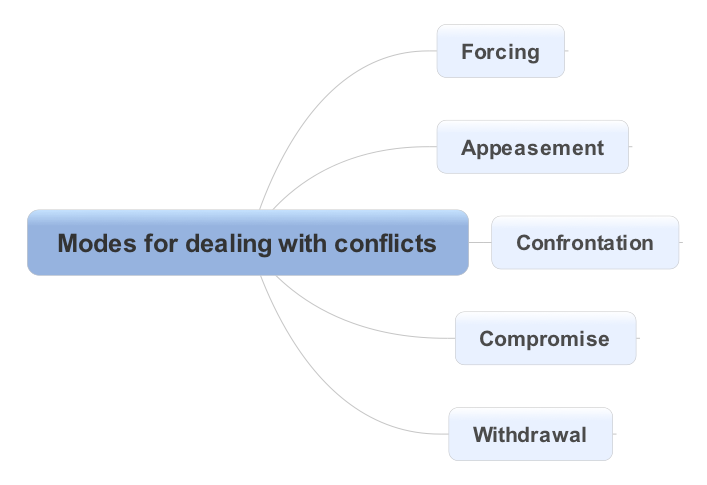
Tool. 5 approaches to address conflict.

Modes de gestion de conflits-EN

Here they are:

Forcing. Firefighter goes into force, and at the sight of flames, I thank them. Evaluate the decision afterwards is a good idea. What would happen, in fact, if there were no flames, finally ?

Appeasement. Two children are fighting for an apple on its apple-tree, but to our surprise, they soon separate without anyone of them having picked anything. Why ? bad fruit, moot conflict. Green fruit, we will continue our struggle at the right time .

Confrontation. Eg through negotiation. But also research , sometimes hard research, a consensus.

Compromise. I take and I leave, and so does the other. In order to keep on going. But what happens if tomorrow I realize that what I won, I care little and what I left, I really wanted ? Frustration.

Withdrawal. I give ground without consideration, for this time. I keep my strength for the future. Or, simply, I realize my mistake. Saying " I was wrong."

Notes:

Conflict is a normal part of the action organized with several Homo Sapiens, and conflict does not automatically lead to violence. It is the absence of speech that leads to violence, not the conflict itself .

These five approaches have their relevance and none is flawless. Now I have my preferences, personally appeasement then forcing. Everyone has their preferences - for you, what are they? The idea is to invite you to learn and train if necessary and to enjoy the other three approaches.

Each approach requires preparation and personal fitness to fire. Again, training is key. In any case, replay—as exposed in a former message of the Leadership chapter.

Experimentation. Experiment with adult-adult dialogues. Prepare the interaction to come.

References. Transactional analysis, negotiation, 5 approaches to address conflict ( PMBOK ) . DRESSLER Larry, Standing in the Fire : leading high-heat meetings with calm, clarity, and courage, San Francisco, CA, Berrett -Koehler Publishers, Inc., 2010.

Stakeholder responsibility. Trustworthy person.

26 novembre 2013

Leadership 1.2. How to rebuild a relationship?

I have had a very bad start in life. When infant I had a problem, I would shout indiscriminately and a goddess, immensely sweet and protective,would solve the problem in two shakes of a lamb’s tail. Sometimes a god would lean over me and soon the goddess would appear in her turn. I was 45 when I heard: You have the complex of the infant! What? You expect that your contemporaries understand your problems at the mere sight of your erratic or violent behavior, you assume they will get you out of trouble and you make them know your disappointment when they do not find anything to help you—or when they do not even try. And then? Well, state your problem aloud! Those who can help you will. Others won’t care.

Assumption. Nonviolent communication banishes killing Yous, it frees speech, it soothes the conflict and clears the field.

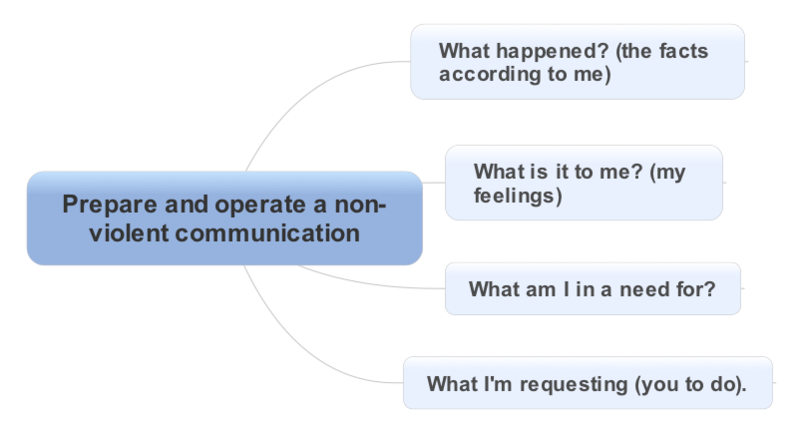
Tool. Non-violent communication.

Préparer et communiquer de façon non violente-EN

For use in two stages: after the event and during the reconnection. This sequence is roughly the same as that of the replay:

What happened ? (facts)

What is it to me? (feelings)

What am I in a need of?

What I'm requesting (you to do).

After the event, within 24 hours , I should say before a second sleep, arise and take the questions in order. Some will do on the phone with someone they trust, other in writing, and others—I am—isolate, even in the toilet (try!).

The writing makes things clear, especially when you adopt these simple rules:

choose specific words. "It hurts me" becomes, for example, "I feel anxious";

wonder what situation it makes you think about, as when "I feel humiliated" becomes "I feel like a scolded child";

keep it short and simple, especially in preparation for the resumption of contact.

Why does the approach of non-violent communication work that well ?

Because it accompanies speech and thereby clears the ground of absence of speech (unjust and violent behavior) .

Because it speaks in the first person: I always have the right to say "I "—and avoids using the "you " who kills the relationship.

Experimentation. Prepare the interview with X, talk with X, debrief this with someone you trust, be yourself a trustworthy person to a colleague.

Elijah. I’m practicing non-violent communication for a few months and I can see a difference. PM. Effective practice. What difference? Elijah. Hard to say, except that now I say things that I kept silent until now. PM. Silent? Elijah. Silent, yes, except that my interlocutors suspected that something was wrong, without knowing exactly what. PM. And since then? Elijah. I found a way to say, and they have clearly listened to me. The collaboration has greatly improved.

References knowing. Non-violent communication .

24 novembre 2013

Leadership 1.1. How to react to an event, an interaction ?

September 2006, Timothy, my son, is passionate about rugby as to register with the local club. November 2006, the All Blacks come and play in France. Since I was in the Parisian hotel where they stayed, I thought of bringing Timothy a signature of a prominent player. My first attempt was a failure. I was bitter, I do not stop there, though. I replayed the event and retried the next day and brought to my son the precious sheet of paper Clarke Dermody hand-signed. Here is how I replayed my first attempt .

What have I done?

I’ve asked for a piece of paper and a pen at the reception desk and went to the manager of the All Black I had seen in the lobby.

- Hello , you are All Black?

- Yes.

- May I have for my son... (I show sheet and pen)

- ( Without letting me finish my sentence ) No, you know, millions of people would like to have it and I cannot answer yes to you and no to the others, sorry.

- It does not matter, thank you.

Game over!

How do I feel?

Grimace. I feel frustrated, misunderstood. We missed one another. I’ve just asked for a signature, even his (I mean, not a player’s), it would have been OK! And what does he tell me about? All signatures of all players? Is that what he understood that I wanted? Then, he was right!

What am I going to do from that point?

To play the extra ball, I decided to prepare my interaction by providing useful information to my interlocutor. My first words and the scenario:

- Hello, I think it's great what you do on the field, it is an honor for us to play with you.

- Thank you.

- My son just started playing rugby, he would be so happy to have your signature! (then, I show the utensils)

- What's his name there ?

- Timothy. It spells T I M O T H E E.

I decided to keep paper and pen in background. Make me understand by the word first, not the gesture which the manager misinterpreted the first time.

What happened then:

The day after the confusion, in the hall again, I see a few players coming back from training. I approach one of them, I start my script. Clarke Dermody plays the game and gives me his autograph. The extra-ball is one of success and Timothy tonight will rejoice, the precious signature in hand!

So, after the event and before the resumption of contact, here is a useful sequence, in order to replay the event.

Relecture-debriefing

What have I done? (facts)

How do I feel about it? (feelings)

What am I going to do from that point? (decision)

Assumption. Replay. Our feelings are a-moral, they are beyond our control. What we decide actually belongs to morality. We can/must make sure that our feelings inform our decisions without taking our place or splashing everyone around us.

From our experiments we can make experience. How ? In replaying. Popularized by the famous Jesuit, St. Ignatius .

Tool. Replay.

Experimentation. Read with someone you trust, be yourself a trustworthy person to a colleague.

References. Ignatian replay.

Stakeholder responsibility. Trustworthy person.

20 novembre 2013

Project 4.2. Enact change, strengthen it.

Assumption. Sponsor speaks and debriefes about the initiative conducted.

Tool. Feedback, ADKAR = Reinforcement. "Act" from the Deming Plan-Do-Check-Act.

Renforcement - Bilan à 6 mois-EN

Experimentation. Invite the sponsor to debrief with stakeholders, to celebrate with them the achievements and to consider what to do next.

REX-EN

References. ADKAR.

Stakeholder responsibility. Sponsor, stakeholders.

18 novembre 2013

Project 3. How to ensure that it works, actually? (deployment)

<<< work in progress >>>

Assumption. What works is what is delivered (delivery = product, process, service, etc.).

What we have designed with a few key users, all users are about to use it. Meet them on their workstations. Observe their actions, collect their feedback, answer to their questions. They are the ones that create value , we are at their service.

GROWDiapositive-FR-EN


Tool. ADKAR = Ability, coaching, mentoring .

The coach, in the strict sense , would not recommend anything, they help the coachee to propose a latent solution in clear consciousness—a maieutic approach.

The mentor is more experienced in the role and the environment, it accompanies and guides the operator through successive steps. The mentor should have no hierarchical relationship with the operator.

Two great tools for a coach: the GROW model and the debriefing.

Relecture-debriefing

Experimentation. Help operators use deliverables. "One Teach One": try training and peer reviews.

"Listen in order to know, teach in order to understand."

A peer: a person of the same job as me, with comparable responsibilities, no hierarchical link with me.

References. ADKAR.

Stakeholder responsibility. Operators’ peers.

31 octobre 2013

Initiative 6 . Finally, shall we launch this initiative?

Assumption. The sponsor makes the decision to launch this initiative preferably to another one. As the initiative launcher or leader, I do expect the sponsor to speak first in front of all the stakeholders and tell them what is changing, etc.

Sponsor's awareness message

Tool. Awareness in ADKAR model, awareness that there is a change in progress.

Whom does the sponsor address? They address the stakeholders among which both operators and supervisors. When? At a meeting, dedicated or not.

Experimentation - skills. Write the final version of the slide Awareness – obtain that the sponsor openly supports the initiative in the directors board and in the stakeholders committee, in whatever committee the initiative may be challenged.

Basically, we’d design the slide for the sponsor to present the initiative to their peers. What should we write on the slide? Answers to those four Awareness questions (same as previously):

  1. What change,
  2. why change,
  3. what risks if we fail and
  4. how it aligns with our business unit objectives.

Feedback

Silas. I've tried to convince the sponsor that she was the one to speak. PM. Her reaction? Silas. Mixed feelings. Not about how good the initiative is, but why pick this one rather than another? PM. Relevant question, of course. Silas. I agree; as far as I am concerned, I would deplore an initiative confiscates me resources under the pretext that it has been approved the latest. PM. Something must remain unclear in the sponsor’s mind: maybe the compelling reason to act? Silas. You bet ; or perhaps she is worried about our ability to finish quickly? PM. Why finish quickly? Silas. This is what I ask of initiatives competing with mine: the faster they are completed, the quicker resources are available again. PM. Sounds logical. Silas. In any case, the sponsor asks me to elaborate first about the four killing questions: need, capability, competition and gain. PM. Where could you find the answers? Silas. In the field. PM. In the field, again and again. Silas. Understood. There I go.

References. ADKAR .

HIATT , J. M., ADKAR Awareness -Desire -Knowledge -Ability , Reinforcement , A model for change in business , government and our community , Loveland, Colorado, Prosci Learning Center Publications , 2006

Stakeholder responsibility. Sponsor.

30 octobre 2013

Initiative 5. What impact does the initiative provoke?

Some stakeholders expected the change in question, indeed. Others did not, hence the widespread idea of a natural , inevitable "resistance to change". Beware of our propensity to filter out facts that oppose our conviction: if "resistance to change" is my motto, I’m bound to sub-esteem those stakeholders who actually wish to change.

What can the initiative do? We have seen initiatives reduce uncertainty relevant for an actor. provide a solution to a difficult problem an actor has been struggling to solve. On the other way round, initiatives can further increase the uncertainty of an actor. The latter has to manage the change without losing face, find a way to justify his salary.

Questionnaire what desire about the change

Assumption. Initiative implies impact on the job and impact on responsibilities—and gains, not just pain.

Tools. ADKAR = Desire questionnaire, Stakeholder register.

ADKAR model designers show that the desire for change is something you can build. The architect of desire is the direct supervisor of the operator concerned who can’ wait for checking how the initiative impacts them with someone who understands and supports them, as appropriate.

Experimentation. Document a draft of impacts and gains at individual stakeholders’ levels.

Strenghtened by discovery interviews (see Environment), 1 - analyze benefits (for the team, for the individual) and impacts (on activities, responsibilities) for each stakeholder in the initiative and 2 – get to each of them in order to confirm / amend , with supervisor’s assistance.

Where to start? By supervisors themselves, top-down—the opposite of the former bottom-up approach of discovery based on the most realistic levels first, operators, up to the big boss, the sponsor.

References. ADKAR .

HIATT , J. M., ADKAR Awareness -Desire -Knowledge -Ability , Reinforcement , A model for change in business , government and our community , Loveland, Colorado, Prosci Learning Center Publications , 2006

Stakeholder responsibility. Stakeholders.

29 octobre 2013

Initiative 4. Why this initiative rather than another?

Assumption. Choice implies renunciation.

Tool. Four key questions, ie the Will adapted from the Way Forward in the GROW model.

Imagine each stakeholder on the brakes. Our goal is that each stakeholder takes his foot off the brake and, having engaged the appropriate gear, presses on the accelerator.

The following four questions we ask each stakeholder—nota bene, indirectly most often: we try to guess the answers to the closed questions from the notes we have taken during an interview. Four "yes", then the stakeholder is ready to move on. One « No » means their foot sticks to the brake pedal.

Is the initiative workable

1. A compelling reason to act? Compelling in the sense that the stakeholder fears worse if the initiative fails.

2. Has the stakeholder some means to succeed? skills, resources? Should those things come to miss, this could be solved with a trainer and a sponsor.

3. Unfortunately , everyone is busy . That new on my desk, am I able to give it priority against other incumbent duties or tasks of mine?

4. Finally, what do I get? Is it reasonable enough compared to the evils that await me?

Experimentation. Surveying stakeholders and completing the register of stakeholders with answers to those four questions.

References. GROW model . http://en.wikipedia.org/wiki/GROW_model

Stakeholder responsibility. Stakeholders.

25 octobre 2013

Initiative 2. Whom does it concern?

Assumption. Stakeholders consider an initiative means changing something.

If we are here, it’s because people in charge of transforming the material or information in the most gross level into something that has value do their job and do it well. The land is plowed , the grain is ground , the baguette is cooked, the knife is sharpened and butter is fresh. In a word, things are well under control, overall. Well enough to provide the basics. Not enough to make you satisfied with it, therefore an initiative launched in order to correct a defect or to prevent an outage.

Let’s call operator anyone who transforms the material or information into something that has value for itself and for the people downstream. « Operator » does not mean "people from below ": a farm worker , a doctor, a minister , all are operators since they transform the material or information they handle into value.

An initiative succeeds only if the operator it concerns operates induced change. Otherwise, the initiative remains sterile. But whatever the initiative is, the operator may feel concerned, because they perceive a change they want or fear. Three uncertainties arise then : what changes does the initiative induce? Who is affected? Will operators collaborate?

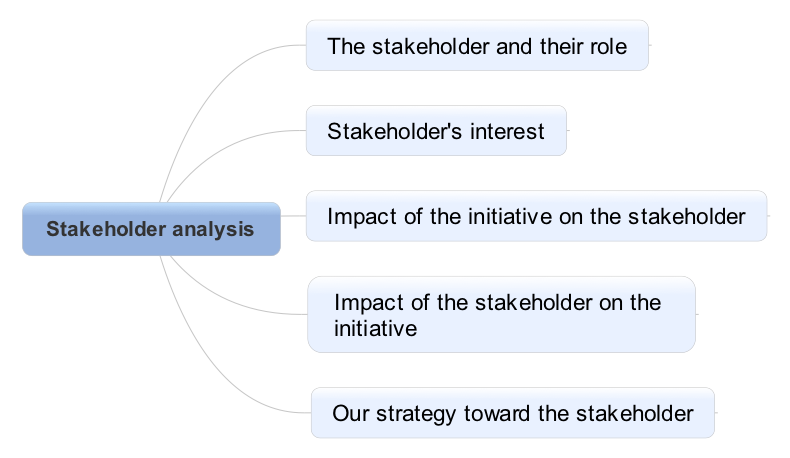
Stakeholder analysis

Let’s go and meet operators before you need it, not knowing at this stage clearly what or who, and let's look at their lives. Three questions will make a difference, in this order: what do you do? what is difficult? whom are you related with? That’s what we have done previously in the systematic discovery of our environment. Let’s be now more specific and open a register of stakeholders.

Tool. Register of stakeholders. Here are the items to determine.

Who / Role / Interest / Impact of the initiative on the stakeholder / Impact of the stakeholder on the initiative / Strategy toward the stakeholder (draft)

Experimentation. Write a first stakeholder analysis and bring it the sponsor to confirm.

References. PMBOK - stakeholders identification and analysis.

Stakeholder responsibility. Sponsor.

11 octobre 2013

Environment 3. What do the relationships between actors mean?

Let me give an example. Rumor has it: train drivers annoyed by their relations with their manager of the schedule. Is it the persons? This is about psychology. Is it that their positions influence persons' behaviors? This is about sociology. Explanations :

Let's try psychology - "Those guys don't get along together well because their characters are incompatible" - Then, logic leads me to a resolution by the good will. I may ask people to water down a little bit, or I suggest to replace one of the persons, or both based on the assumption that the new person(s) will solve the problems.

However, do we need to appeal to psychology, while we may apply more direct an approach? Let's assume that relations are rooted in uncertainty anyone feels--and that people adopt strategies to deal with their uncertainties. We consider relationships between two people more like relationships of actors in the action system than personality interactions.

Train drivers, tired of being held in distant homes, consider rotations schedule in coming weeks their most painful uncertainty. Who manages this uncertainty? the manager of the schedule. The latter makes tedious, complex calculations every time they have to schedule a new service: should a train driver add his last minute requirement and it is a new painful calculation run. A balance of power. Note, this might be in a collaboration mode. It's up to the actors to choose.

A foreman, measured on the number of engines that come out of their assembly line, faces surprises that come from workshops upstream (insufficient production, incident delivery, ...). Lacking hierarchical power over their predecessors in the value chain, they play their personal power, yelling and/or threatening. The role makes it so--and foreman's psychology has to bear the pressure the role imposes.

Assumption. Relations between actors point out alliances and protections in a system.

Tool. Sociogram.

Experimentation. Develop a sociogram based on past interviews and make interviews for confirmation.

References knowing. Sociogram and action system according to Crozier & Friedberg

Stakeholder responsibility. Myself.

Relationships : System's responsibility

An approach as a sociologist rather than as a psychologist, what's the  benefit to us?

The persons have not full control on changing themselves (psychologist's point of view), whereas they may work on their acting, they may modify, optimize it to a greater extent (sociologist's point of view). "Do not take it personal " takes on its full meaning here : it is your role, your acting that I'm challenging, not your person .

We see a relationship as an alliance or repulsion marker between two actors in the system rather than (dis-)agreement between two characters or two psychologies.

When does psychology contribute? Well, an individual's psychology supports this individual's acting. If a person replaces somebody in a given position, this person is likely to develop similar character traits because of the position pressure, provided that their personal psychology allows them.

Sociogramme-Diapositive-EN

Time for action

Draw a diagram on the people and the relationships among them. An given relationship gives an arrow. The more intense relationship, the thicker the arrow. Give a sign to the arrow, according to the emotions evoked by the person as to his relationship: "+" for a good relationship, "-" for a bad , and the double sign to mark a high intensity, if applicable ( "++" , etc . ).

In parallel, keep on interviews (three questions: what do you do, what is difficult, whom you work with). Meet people whom your contacts so far have talked about, whom they are related with. Prefer meet people closest to the ground first, often those whose position is at the bottom of the chart.

debriefing

Why prefer to start at the bottom of the scale of the organization?

1) for you to get to know the concrete problems

2 ) to obtain freer a speech

3 ) to collect objective information before getting to the management levels

Why wait for interviews before drawing the sociogram ?

What can we do with relationships in +/- , not really good or bad ?

Is it possible that a person's character be decisive in his acting ? Yes, if the position is difficult to cope with (pressure, uncertainty, personal attacks, destabilization), psychological resources are heavily used to hold the seat. However, strong psychological resources are necessary but insufficient.

Pascal. What should I do when I receive the formal prohibition to meet a particular person (the client, the principal investigator, etc.)? PM. Where does the ban comes from? Pascal. From the great stroumf. PM. High up, then. Pascal. Why is not meeting a stakeholder a problem? What should I bother? PM. Let's assume that a stakeholder has his foot on the brake; they may keep on the brake until you meet them. Pascal . Failing to meet a stakeholder would generate opposition later? PM . In this case, yes, an opposition. Pascal . Does the relationship between the sponsor and the forbidden stakeholder matter? PM . Say , if the sponsor has a bad relationship with the forbidden stakeholder, the initiative could be doomed. However, people involved in an action system stand failures provided that their gains outweight their pains. You'd be better inquire about those gains.

Gilles. I saw a newly appointed PM taking their assignment in Asia. They spent six weeks in meeting each of the stakeholders, including leaders and managers of project resources. PM. What was the project like? Gilles. It was to build an entire plant from bare land. PM. High stakes, I suppose. Gilles . Yes, indeed. And they took some time. PM. What did the final result look like? Gilles. Well, the project is a success; I have experience of similar projects, some are considered as major failures. PM. How do you think meeting with stakeholders, as did the PM, contributed to the performance? Gilles. As far as I know, they could count on stakeholders whenever it was needed. PM. As if meeting stakeholders makes them release the brakes? Gilles. You bet. Do they accelerate, afterwards? this is another story. But at least the brakes are released. PM. Meet people, release brakes. Gilles. This sounds like meeting people is giving them consideration. PM. How do you feel when a stranger asks you to commit to something? And how do you feel when, another scenario, the person takes the time to listen to you before asking for anything? Gilles. Very different scenarios, indeed. PM. So, what would you like to do now? Gilles. I'd like to meet with stakeholders before I have to ask them the tiniest thing.

The next step

When should you proceed to the next step ? When you've been around actors. For example, when you've already met people your interviewees claim they are related to.

The next step is to identify the uncertainty the system manages.

9 octobre 2013

Environment 1. Where do I fit in?

Assumption / assertion: I'm an actor in the sense of the sociologist-- broader a sense than the dramaturgical meaning. I have my own goals for myself, beyond those of my position / organization, I have an autonomy (management of my subjects, my time, my resources, ... ), I act with good reasons--even if those reasons are my own--, I experience uncertainties which I look forward to reducing. Finally, I can make some people do what they would not have done without my asking them, a working definition of power.

Actor

Tool - skills: Questioning for discovery, three issues to be addressed in this order: what you do, what you find is difficult and the relationships you have with other people or roles.

Experimentation - know-how: self- questioning

You can choose between two environments:

1) You may want to work on your present job.

2) You may prefer to work on a project, a past job. In this case, preferably choose a topic as recent as possible .

Having chosen your environment, ask yourself what you are/have been doing, which is difficult for you and with whom you interact.

What you do. Not quite the job description, but what you actually do. Describe your typical day, how you start in the morning, etc.

Which is difficult. There is always something difficult in what we do. This can be a concern. This can be a soluble or insoluble problem, a difficulty resolved or in the process of being resolved, a technical or relational concern.

With whom you interact. Individuals or groups of people.

Questionnaire for discovery

Add a sign on each relationship: is it warm? note "+". Is it tense? note "-". Emphasize the strength of the relationship, put several signs if you feel like it: "+ +" , etc.

Stakeholders Involved: Myself. Yes, it is mine to start doing it.

Feedback dialogs

Sarah. I started listing my job, but I quickly moved to what I do every day, there is a lot of relationships with others, many different people. PM. That's different from the job description. Sarah. I'm impressed, I did not expect that. PM. A lot of relationships. Sarah. That is the essence of my day. I do my best, I go by feel with people, but sometimes it does not work. When my contacts are another department, they tend to refer me to their leader, and when they are within my own department, they are nice but not very competent, so it takes time. Everything takes time. It's amazing how long it takes. I feel discouraged sometimes. PM. As if you'd burn a lot of energy. Sarah. Or rather the feeling of moving slowly, very slowly, as if the organization had a headache.

Sophie. I do not see the point of spending time to ask these questions, I know very well what I do, what is difficult is to complete my job and that's all, and I work for a whole lot of people. PM. Everything can continue as it is, the situation is under control. Sophie. Not quite, but it's my job to bring it under control, actually. PM. What do your colleagues say? Sophie. They say it's the same for them, but I do not think so. There are people with whom it does not work, who refrain from cooperating, who think only about their problems. PM. So, it looks like the control is not total. Sophie. They want to keep control over what they do, I understand that. PM. So they create uncertainty for you. Sophie. Yes, they create uncertainty for me. And I do not like it .

The next step

Having started with ourselves, continue the process by meeting colleagues (both horizontally and vertically) , starting with those in the most modest positions in the hierarchy.

References: Actors in a system, Crozier-Friedberg . The central idea is that the players have good reason to act as we see them do, we have to discover these reasons. Note that Crozier-Friedberg hypothesize that actors have the psychological resources to play their part; this is where they lean towards psychology. Specifically, if we replace a weird player by a so-called sane person, this logic would dictate that the new actor soon takes tics of their predecessor due to the same parameters in an equal position.

CROZIER M., FRIEDBERF E., Actors and Systems, 1981, Chicago University Press. More detailed, more technical. A reference.

10 octobre 2013

Environment 2: what roles do they play?

Assumption. Those around me are also actors within the meaning of the sociologist.

Tool - expertise. Questioning of discovery, the same as before : what do you do, what is difficult, with whom you have a relationship.

Experimentation - skills. Solicit interviews and write down you notes.

Go and meet your colleagues. Start informally by those who are close, prefer the more modest levels of the hierarchy.

As part of a project, you may want to make formal appointments. Today, let's start informally.

Still the same three questions, this time on the present environment :

Questionnaire for discovery

  1. What do you do?
  2. Which is difficult?
  3. With whom do you interact?


As for yourself at the first time, take interested in your contact's typical day, in their difficulties resolved or about to be, or technical and interpersonal relations with other people in their environment. Again, identify the sign of each relationship (is it warm ? is it tense?); note relationship intensity, strong or weak.

It is common that interview continues, ¾ to 2 hours. This is important for making an appointment. My personal practice : offering a ¾ hours slot at a time of the week or the day when an overflow is possible; a few minutes before the end, I ask my vis-à-vis how they wish to proceed. Most of the time, they want to continue the interview .

The subject should be the present environment and not a past situation. Some of us need to touch, to visit in order to understand; as it is feasible under the present environment, it is difficult for the past. In addition, the memory selects memories; interviews that focus on present situations have easier objectivity.

Can we do these interviews over the phone? At first, absolutely prefer the physical presence to sit next to the person, if necessary. It is for us to perceive by our five senses what the person communicates to us .

Debriefing

The debriefing is based on three questions, in this order:

Relecture-debriefing

  1. What have I done?
  2. How do I feel about it?
  3. What shall I do from this point?

In a workshop, a facilitator want to organize the debriefing in small groups of 3-4 people and give each group an object: a pen, whatever fits in one's hand. The person who receives the object speaks, and when finished, sends the object to the next person. This promotes speaking and mutual listening.

In the context of a single process, you can open a notebook and use writing. In this case, once a month or more frequently, share verbally with someone you trust. This helps keep oneself on a realistic trend.

Experience feedback

Charles . I discovered that some save the situation regularly, almost daily. I had no idea what people really live. PM . They save the situation. Charles. Yes, they solve problems in everyday life. Fortunately they are there. PM. What do you feel ? Charles. I feel wonder and gratitude. They help to keep the boat floating and moving forward. PM. They also help to make the boat where you are. Charles. For some, I imagined they were refraining from working, but in fact they scoop a leak I had no idea about. PM. You discover a corner of your environment. Charles. I will continue my meetings. I'm curious about what I discovered, it gives me energy.

Philippe. During my visit, I was often dealing with people who want to know what others have said. How should I react? PM. They want to know what others are doing. Did they seemed suspicious? Philippe. Yes, somehow worried. PM. Sometimes we wanted to know what the questioner may do with information that we give. When they speak of those they have interviewed before us, we check our interviewer. Philippe. Is it an indirect way to ask them what they make of what they heard? PM. Yes, in a roundabout way. Philippe. For now, I said what I meant did not come out of my notes, and it was meant to help me understand my environment. It has seemed to suit them. PM . They concluded that they could talk about without what they say being repeated .

The next step

When proceeding to the next step ? When you met all people who surround you directly .

Our next step is to draw a sociogram : relationships between people, relationships that conceal a logical system whose knowledge would facilitate our efforts to come.

References knowledge. Interview of actors in a system, Crozier-Friedberg's strategic analysis.

Stakeholder responsibility. Those around me.

28 octobre 2013

Initiative 3. Why should we launch it?

Assumption. Initiative implies sponsor, sponsor implies top-down communication .

The authors of ADKAR model highlight that a person in a situation of change expects before any other communication that a big boss show them the goal. In four points:

Sponsor's awareness message

1 . What is changing?

2 . Why we are committing ourselves in this change?

3 . What risks do we take if we fail this change?

4 . How does this operation align with the objectives of our business unit , ie our working group / service?

Tool. Adkar = Awareness questionnaire.

Experimentation. Write a first slide with the Awareness messages and bring it to the sponsor to confirm.

This is a key test for identifying the sponsor of the initiative : if the person you identified as the sponsor enters the process and welcomes the prospect of getting up to face the crowd and recite the creed in four points, you actually hold the Sponsor. Otherwise , look again. See message in " Environment Pilot in the plane."

References. ADKAR .

Stakeholder responsibility. Sponsor.

18 octobre 2013

Environment 5 . Is there anyone to pilot the plane?

Look at the sponsor : you know the future of the initiative: the stronger the sponsor , the more energetic the initiative. When do you check checks how strong the sponsor is? When you cannot get yourself out of a situation, you call the sponsor and look at what happens.

Assumption. The sponsor has a limited rationality and limited enforcement powers .

A rationality limited by the time they can devote to study, by political pressures and constraints, by their own cognitive abilities and knowledge at the very moment, their cognitive biases such as halo effect , beliefs, etc. .

A limited enforcement power, as much as results of their top-down injunctions. Rumor has it, there are organizations where the fallen top-down order reaches its target and produces effect. The army ? Churches ?

Tool - expertise. Operational definition of the Sponsor.

Le commanditaire-EN

A " Sponsor " has these three attributes : 1 - power, 2 - resources and 3 - a personal interest in the success of the initiative .

1 - power : high enough in the hierarchy.

2 - resources , in person or by delegation / negotiation . People , things, money .

3 - personal interest , so it’s a person, not a group. Where all are responsible, in case of problems , nobody really is.

Experimentation - skills. Identify the sponsor of the initiative.

Search among stakeholders a person with the three attributes above.

You may end up with several sponsors.

Some sponsors are unaware of their sponsoring the initiative, we need to reveal themselves. Train them in their role, help them.

References. PMBOK - definition of sponsor / sponsor.

Stakeholder responsibility. Sponsor.

15 décembre 2013

Ce que vous trouverez là. What you may find in this blog.

Note to non French speaking readers. This is all about initiative management, including project and change management. Most of the times, I've posted the corresponding message in English right after each French message. You may also refer to the index page in English to access a given message directly--messages written in English.

As of 2015, Feb. 12: I'm improving the English version with a native English speaker. Work in progress. 


SchemaGlobal-v0

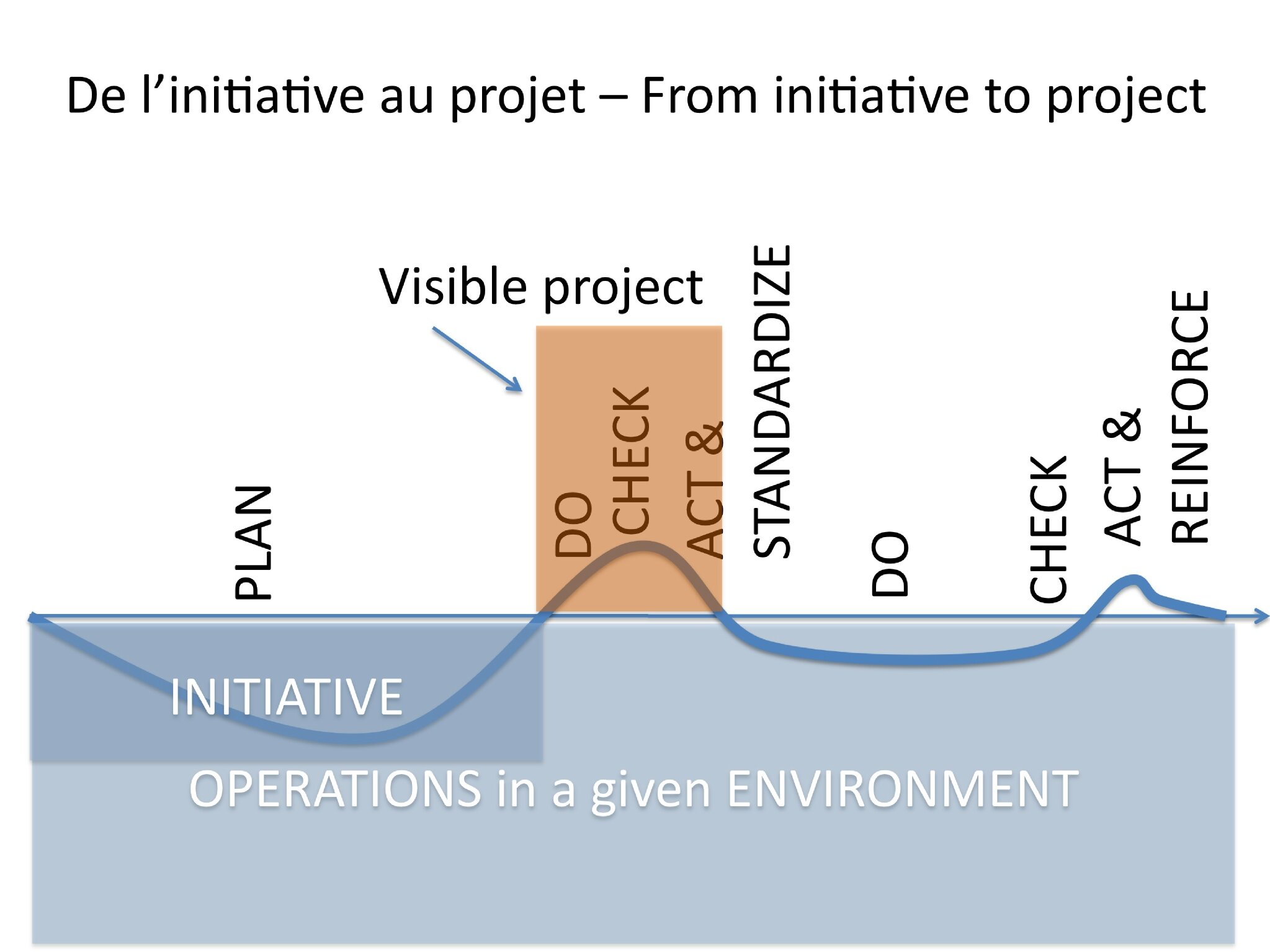
La roue de Deming appliquée à un projet. Un projet donné contribue à atteindre un objectif en tant que partie d'un tout. En effet, avant tout projet, il y a une initiative du genre "Nous voulons obtenir tel résultat". Lorsque l'initiative aura mûri, elle s'exprimera ainsi : "Nous voulons obtenir tel résultat EN lançant tel projet". Et puis, une fois le projet terminé, les opérations commencent et, afin de soutenir le changement introduit par le projet, on doit mener une opération de renforcement.

Deming's Plan Do Check Act applied to project. A given project contributes to reaching a given goal as part of a bigger picture : before any projet, there is an initiative like "We should get that result". As the initiative evolves, you have "We shall get that result BY doing this project". Moreover, once the project close, operations start and some reinforcement is required to sustain the change the project has brought in.

 --- en français ---

Dans ce blog, vous trouverez :

a- Un credo, ce que je crois et dont le reste découle (depuis Mac Gregor, on soupçonne que des croyances sont auto-réalisantes). http://initiative101.canalblog.com/pages/mon-credo--francais-/28904741.html

b- Quatre thèmes avec questionnements et exercices pratiques :

1. Quelle est ma place dans mon milieu ? Quels rôles ceux qui m'entourent jouent-ils ? Que signifient les relations entre acteurs ? Qu'est-ce qui explique que le système, bien qu'imparfait, perdure et soit stable ? Y a-t-il un pilote dans l'avion ? C'est l'objet de la section Environnement et des exercices qui s'y rattachent.

2. Une initiative, ça sert à quoi ? Qui cela concerne-t-il ? Pourquoi la lancerait-on ? Pourquoi cette initiative plutôt qu'une autre ? Quel impact aura-t-elle ? Alors, finalement, on la lance ? Voyez la section Initiative et ses messages. Pour une fiche résumé directement utilisable en situation : Initiative_GROW_ADKAR_Mod_leFR_v2

3. Qu'est-ce qu'il faut faire, au (plus) juste ? (Conception). Nous produisons, certes, mais comment produisons-nous ce que nous sommes en train de produire (how good, fast and cheap) ? (développement). Comment s'assurer que ça marche, sur le terrain ? (déploiement). Jusqu'à quand fait-on l'effort ? Comment s'assurer qu'on évitera ces ornières la fois prochaine ? (clôture). La section Projet répondra avec exercices et outils.

4. Comment transformer ses expériences en expérience ? Untel et moi nous sommes emportés l'un contre l'autre : comment travailler avec lui/elle dès demain ? Comment se sortir d'un conflit ? Comment aboutir à un accord dans une confrontation ? La section Leadership nous aidera à convertir nos expériences en expérience.

c- Une bibliographie. Lire, c'est affûter ses outils. Voir la page dédiée à la bibliographie.

     --- in English ---

In that blog, you'll find:

a- a credo, what I believe and the consequences of it (from Mac Gregor , we suspect that beliefs are self-fulfilling). http://initiative101.canalblog.com/pages/my-credo--american-english-/28904790.html

b-Four themes with questions and practical exercises:

1 . What is my place in my community? What roles do my neighbors play? What do the relationships between actors account for? What does explain that the system, although imperfect, continues to be stable? Is there a pilot on the plane? This is the purpose of the Environment section and exercises related to it.

2 . Initiative, what is it? Who should I consider as stakeholders? Why should we launch the initiative? Why this initiative rather than another? What impact will it have? So, do we finally launch it? See the section Initiative and its messages. Here is a useful template you may use right now: Initiative_GROW_ADKAR_v0

3 . What should we do, at the fairest? (Design) . We produce, of course, but how are we producing our deliverables (how good , fast and cheap)? (development) . How to ensure that it works on the field ? (deployment) . How to know when to stop working on it? How to make sure we avoid the same pitfalls next time? (closure). Look at the Project section with exercises and tools.

4 . How to turn our experiments into experience? John Doe and I got angry against each other: how can I work with them tomorrow? How can I manage and solve a conflict? How can we reach an agreement together in a confrontation? The Leadership section will help.

c- A bibliography. Reading is about sharpening our saw.

13 novembre 2013

Project 1.2 . From objective to what we have to develop (design)

Assumption. Design deliverable with users. Aim some « just enough » or « bare essentials » : this is what has value – what I offer beyond that very « just enough » will always be considered too expensive, no matter how cheap it may be.

Tool. Objectives -> Roles -> Needs -> Features -> Use Cases -> What is left to develop.

Goal-to-FeatureGraph-EN

1. Express objectives of the initiative.

  • Make a bicycle trail between factory buildings to decongest roads and parking lots.

2 . Identify the roles which the target has impact on.

  • Bike users,
  • those who hold them in condition and repair,
  • those who buy bikes,
  • pedestrians,
  • car drivers,
  • truck drivers,
  • those that monitor the employees’ health,
  • those who communicate about the plant.

3. Collect information from stakeholders about their needs for each role.

  • Users want to avoid arriving sweaty,
  • they don’t want to take a shower at destination ;
  • those who maintain bikes wish to limit the number of trivial repair, punctures for example.

4 . Describe the user stories of each role about every need.

  • Bike users want the most direct route between two points, avoiding stops (traffic lights) and abrupt changes in altitude to avoid sweating uphill and cooling downhill,
  • those who maintain wish to repair as few punctures as possible, so they like easy-to-clean bike paths (shards of glass, nails, etc.) and safe trails (avoid going over leaves, avoid locations where the wind imbalance cyclists, etc.) to limit the number of bikes out of order.

5 . From user stories, deduct the features of the product / service to meet user’s expectations, which are optional and which are mandatory with high priority.

  • A main track and shortcuts trails,
  • a priority rule (bikes over cars and pedestrians over bikes),
  • not more than 3 % slopes,
  • electricy-powered bikes,
  • street cleaning machine once a week from December to August and twice a week from September to November,
  • puncture-proof tires,
  • a windsock at dangerous points to indicate a strong wind.

6 . Define what’s left to develop , ie deliverables to develop and deliver first to provide high-priority functionalities.

  • A map with trails, crossings, dangerous points, signs installed along the tracks ;
  • buckets of special road paint (non-slippery paint for two-wheelers),
  • marking bike paths,
  • three windsocks,
  • an article in the local paper to advertize our endeavor,
  • etc.

Experimentation. Design deliverables with users—and validate , validate, validate .

Feedbacks.

Bertrand. I have performed a comprehensive analysis yesterday—at least I thought. PM. What happened? Bertrand. I have presented my findings to colleagues and a quarter of an hour later, there was nothing left of my plan. PM. In what sense? Bertrand. Well, they have found my ideas were not bad, but they started arranging and specifying, each for their own job and role. PM. How do you feel? Bertrand. I’m tired of my nightly research and I’m disappointed that it did not survive the confrontation. PM. Tired and disappointed. Bertrand. Indeed. That said, what comes out is pretty good: it's theirs, at least. PM. They have considered your approach. Bertrand. That's right, they have adopted the approach a step further towards developments that I had not anticipated. PM. It takes an unexpected turn. Bertrand. Say it is not what I had in mind initially. PM. Well, let's go with them, since they are on board. 

References. Value Analysis , ADKAR , Agile - Scrum .

Stakeholder responsibility. Users.

24 octobre 2013

Initiative 1. Initiative, what for?

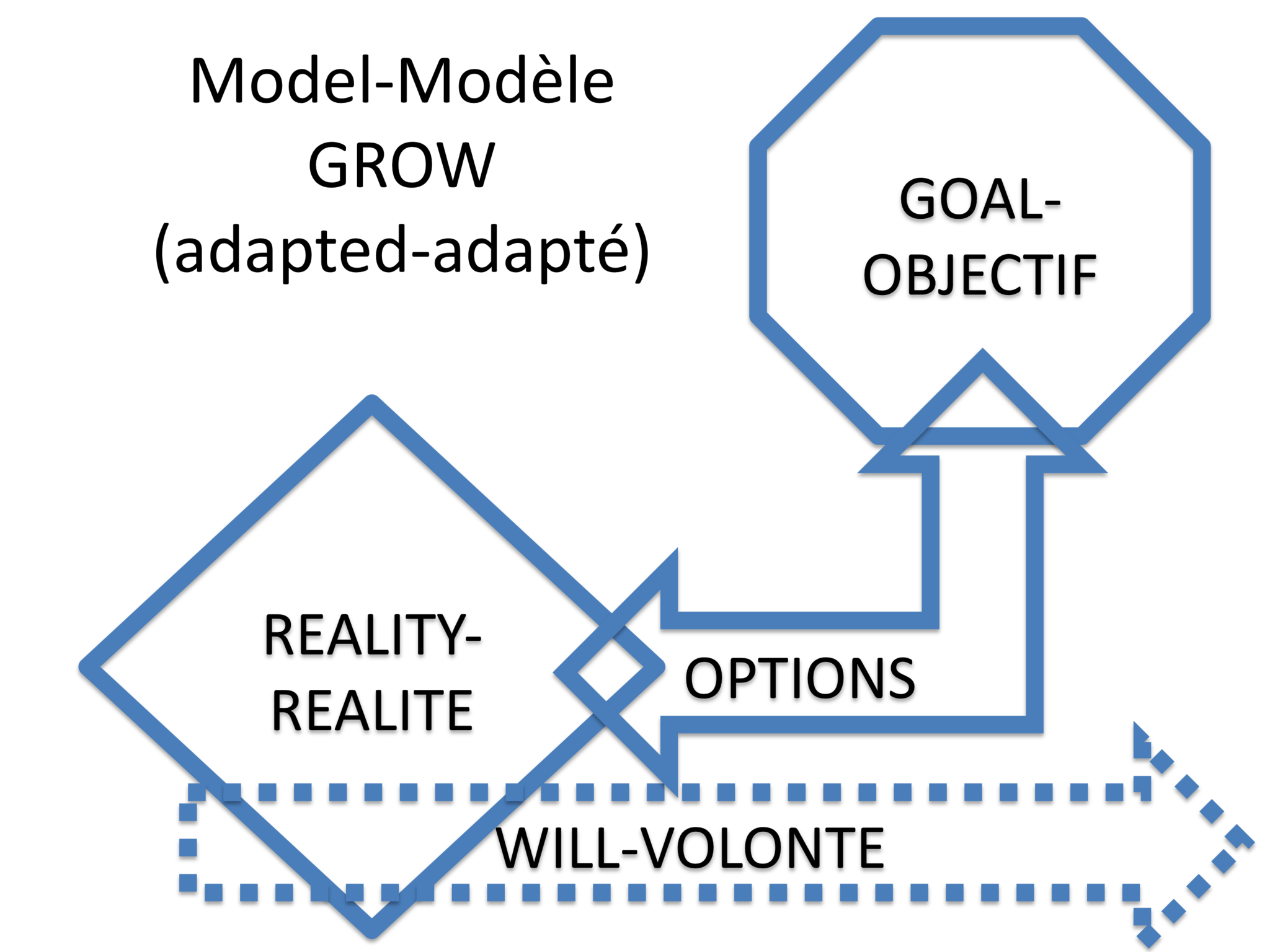
Assumption. Anyone in charge of an initiative seeks to achieve G (Goal) starting from R (Reality) through O (Options, steps). All supported by W (Will).

Tool. GROW model.

GROWDiapositive-FR-EN

What is the desired state ? Let’s use some "visioning", ie close our eyes, imagine we are some day six months from now, describe what we see : the state in which we wish to find us at this time. This is the Goal.

From there, let’s look back to our situation today and describe that. That’s Reality.

Then let’s consider what we have done to achieve the Goal from Reality ? Those are the Options, often in several stages more or less independent .

On a slide, Options depart from Reality in the bottom left to climb stairs towards the Goal in the top right. Each step is an initiative . You may choose descending stairs, always from left to right in the direction of reading, with that idea in mind that the movement is made easier, as accompanied by the forces of gravity.

And W, you say? W as Will. Let’s measure, for each stakeholder individually, the number of "yes" they answer to the four questions below :

Is the initiative workable

  1. Have I got a compelling reason to act ?
  2. Have I got the ability to perform this action ?
  3. Can this action win the competition against all others I have to do now ?
  4. Is the pain worth the gain?

Four Yes: active cooperation. One No, weak commitment. Two Nos, blockade. Etc.

Experimentation. Develop a slide with GROW and present it to the sponsor.

The sponsor is sometimes the last person interviewed. Let’s synthesize and let them validate our findings—taking care to speak a language they understand: visual, auditory or kinesthetic.

How to identify the sponsor ? see a previous post of the family of the "environment " .

Feedback.

Pascal. And what to do when one has no idea of the objective? Say there is a compelling reason to act, to change something, but nothing more? PM. Well, anyway, let’s start trusting those who do, because they are the ones who know (this is my working hypothesis, my belief , my credo, and Kaizen’s too). Pascal. Are there examples where it has been successful? PM. Yes, indeed, examples documented in FAVI, a foundry of the Somme (http://www.favi.fr/managf.php). Pascal . And otherwise? PM. Without a goal , we could consider a meta-goal as making our customer happy. Pascal. Common sense, isn’t it? PM. You bet. Except that since 35,000 years we trade with each other and that we evolved with the exchange of goods and services. There are more than being paid for goods or services rendered. There’s the relationship. Pascal. The relationship as meta- objective, beyond customer satisfaction? PM. Correct. What could "let’s make our customer happy?" change in your daily activities?

References. GROW model . I freely interpreted the "W" in Will rather than Way Forward (next steps / action plan) as initially meant. In my opinion, no matter the action plans, stakeholders are found the foot on the brake by default.

Stakeholder responsibility. Sponsor.

Publicité
<< < 1 2 3 4 5 6 7 > >>
Le juste nécessaire pour réussir un projet de changement avec vos collègues.
  • Vous prenez une initiative ? Faites-la réussir. Ca ne dépend pas que de vous ? Vous avez ici et maintenant tout ce qu’il faut pour faire adhérer vos collègues. Grâce au juste nécessaire, trouvez comment réussir avec eux votre projet ! Pascal LE DELEY, PMP®
  • Accueil du blog
  • Créer un blog avec CanalBlog
Publicité
Visiteurs
Depuis la création 43 377
Publicité
Publicité